Tutorial
Economics 101: Crash Course Econ Episode 1
You can vote once per content item.
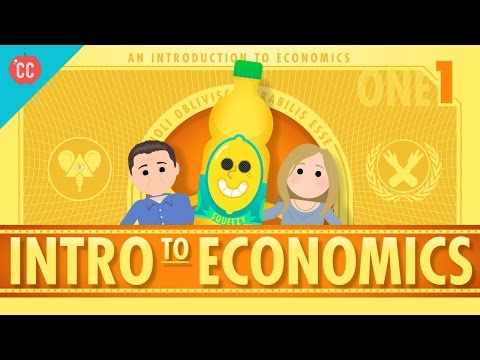
When you hear the word economics, you might think about money, the stock market, business, or complicated charts and forecasts. But economics is much broader than that.
At its core, economics is the study of people and the choices they make. It helps us understand how individuals, businesses, and governments make decisions when resources are limited and there are competing ways to use them.
That makes economics relevant to almost everyone. Whether you’re deciding whether to work or study, a company is deciding what products to make, or a government is deciding how to allocate public resources, you’re dealing with economic choices.
Economics Is About Choices
One of the most important ideas in economics is that we can’t have everything we want.
People have unlimited wants, but the resources available to satisfy those wants are limited. Economists call this condition scarcity. Because resources are scarce, individuals, businesses, and governments have to make choices about how to use them.
For example, imagine you have an evening free. You could study, watch a movie, exercise, spend time with friends, or simply relax. Choosing one option means giving up the opportunity to spend that time on another.
This leads to another foundational economic concept: opportunity cost.
What Is Opportunity Cost?
Your opportunity cost is the value of the next-best alternative you give up when you make a choice.
Even something that appears to be free can have an opportunity cost.
Suppose you’re watching an economics video online. You may not have paid any money to watch it, but your time is still limited. You could have spent that same time watching another video, studying, exercising, or doing something else.
The opportunity cost is the value of that next-best alternative.
Thinking about choices this way can change how you approach everyday decisions. Instead of asking only, “What does this cost?” you can also ask:
“What am I giving up by choosing this?”
Every Choice Has Benefits and Costs
Economics also teaches us to think about decisions in terms of benefits and costs.
Individuals, businesses, and governments constantly weigh potential benefits against potential costs. They cannot have everything, so they must decide which choices make the best use of their limited resources.
This idea applies to major public decisions as well as personal ones.
For example, resources devoted to one purpose cannot simultaneously be used for another. Spending resources on military equipment means those same resources are unavailable for other possible uses, such as schools, hospitals, or roads. This is an example of opportunity cost at the level of government.
Economics doesn’t automatically tell us which choice is correct. Instead, it gives us tools for understanding the trade-offs involved.
Why Incentives Matter in Economics
Another major concept introduced in the course is incentives.
An incentive is something that influences people’s behavior. When governments, businesses, or other organizations design policies, the incentives they create can affect how people respond.
Consider universities. If schools receive funding simply for enrolling students, they may have an incentive to focus on recruitment. If funding is instead connected to students completing courses or earning degrees, the incentives change.
But incentives don’t always produce the intended results.
The transcript gives the example of a rat-control program in colonial Vietnam. A bounty was offered for rat tails, but some people reportedly responded by cutting off rats’ tails and releasing the animals so they could reproduce. The policy therefore created an unintended incentive and failed to achieve its intended goal.
This illustrates an important lesson:
When evaluating a policy, it isn’t enough to look at what it is designed to accomplish. You also need to consider how people are likely to respond to the incentives it creates.
Microeconomics vs. Macroeconomics
Economics is a broad field, and one of the most important distinctions for beginners is between microeconomics and macroeconomics.
What Is Microeconomics?
Microeconomics focuses on individual people, businesses, and specific markets.
Questions might include:
- How many workers should a company hire?
- When should a business launch a new product?
- How do consumers respond to prices?
- Which policies might influence people’s choices?
These questions focus on individual economic decisions and interactions.
What Is Macroeconomics?
Macroeconomics looks at the economy as a whole.
It examines topics such as:
- Economic growth
- Unemployment
- Inflation
- Interest rates
- Government spending
- National economic output
Macroeconomics asks questions about large-scale economic conditions, such as how changes in taxes or the money supply might affect the broader economy.
A useful way to remember the difference is that microeconomics looks at individual parts of the economy, while macroeconomics looks at the economy as a whole.
Why Learn Economics?
You don’t need to become an economist to benefit from learning economics.
The ideas of scarcity, opportunity cost, incentives, and trade-offs can help you understand decisions that appear in everyday life as well as larger debates about business and public policy.
Economics can also provide a framework for thinking through problems rather than simply reacting to them. As the course explains, understanding economics can help you better understand the world and become a more informed decision-maker.
And this is only the beginning. The course goes on to explore topics ranging from supply and demand to monetary policy, building on the foundational ideas introduced here.
Watch the Economics Crash Course
Ready to see these concepts explained with real-world examples, humor, and visual demonstrations?
Watch the full video to explore the foundations of economics, including scarcity, opportunity cost, incentives, microeconomics, and macroeconomics.
The video is a great starting point if you’re new to economics and want to build a strong foundation before moving on to more advanced topics.
Watch the video
Prefer to learn by watching?
Open the dedicated video page to watch this lesson.
Watch video →